Radon Testing and Mitigation
EducationRadon Testing and Mitigation

Radon is a cancer-causing, invisible gas formed through the natural breakdown--radioactive decay--of uranium. Homeowners in the United states became aware of radon in the 1980’s. Homes in every state in the country are susceptible to elevated levels radon, but there is variability of how much radon enters any given home home, primarily due to local geological features. The highest average radon concentrations in the United States are found in Iowa and in the Appalachian Mountain areas in southeastern Pennsylvania. ("Predicted County Median Concentration". Lawrence Berkeley National Laboratory. Retrieved 2008-02-12.)
Stanley Watras was an employee at the Limerick nuclear power plant who set off the radiation alarms on his way to work in 1984. Other employees searched his house and found that he had radon poisoning in his basement that was unrelated to the nuclear power plant. It was calculated that about 2,700 pCi/L was contaminating his house and the risk of living there was equal to that of smoking 135 packs of cigarettes a day. This was the first time evidence of the danger of radon exposure was found. After this, standards were set and most homeowners began concerning themselves with radon levels. (Harrison, Kathryn; Hoberg, George (1991). "Setting the Environmental Agenda in Canada and the United States: The Cases of Dioxin and Radon". Canadian Journal of Political Science 24 (1): 3–27.
Radon is the heaviest known gas and is nine times denser than air. Because it is a single-atom gas, it can penetrate many common materials like paper, leather, low density plastic, most paints, and building materials like gypsum board, concrete block, mortar, tar paper, wood paneling, and most insulations. Fortunately its half-life is under 4 days so that once it enters your home; it doesn’t stay around for long.
Radon seeps into your home from the surrounding soil, and sometimes contaminates well water. It's the second leading cause of lung cancer in the United States, with only cigarette smoking causing more lung cancer deaths. There is some dispute to how many deaths can be contributed directly to radon, but the evidence points to a very high number.
The action level for radon 4 pCi/l, pCi/l stands for pico-curie per liter which represents the radiation given off by the substance for a given volume. A family whose home has radon levels of 4 pCi/l is exposed to approximately 35 times as much radiation as the Nuclear Regulatory Commission would allow if that family was standing next to the fence of a radioactive waste site. (25 mrem limit, 800 mrem exposure). Congress passed the Radon Act 51 which set the natural outdoor level of radon gas (0.4 pCi/L) as the target radon level for indoor radon levels. Unfortunately, two-thirds of all homes exceed this level. Any amount of radon brings with it some elevated risk of cancer. (Sources: EPA, www.radon.com )
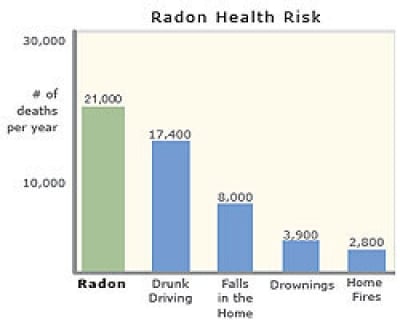
* Radon is estimated to cause about 21,000 lung cancer deaths per year, according to EPA's 2003 Assessment of Risks from Radon in Homes (EPA 402-R-03-003). The numbers of deaths from other causes are taken from the Centers for Disease Control and Prevention's 1999-2001 National Center for Injury Prevention and Control Report and 2002 National Safety Council Reports.
While radon in water is not a problem in homes served by most public water supplies, it has been found in some well water. Also some municipal water systems utilize artesian (well) water, so you should obtain a copy of their annual testing report. If the air in your home has been tested and there are elevated levels of radon, and your water comes from a well, contact a lab certified to measure radiation in water to have your water tested. If you're on a public water supply and are concerned that radon may be entering your home through the water, call your municipal water company.
Most building materials contain some amount of radon, but radon from the soil is by far the greatest cause of elevated radon levels. Granite, natural stone, clay tiles, even natural gas, all contain radon, but at levels that are difficult to quantify and determine the true level of radon emissions. Some sources show granite countertops being tested with a Geiger Counter, but this only indicates that radon is coming from that spot, not how much radon is there. This is why all radon tests are conducted over a set period of time.
Testing
Testing is an inexpensive way to determine the levels of radon in your home. They can be short-term (several days or months) or long-term (up to a year) test. Reliable testing devices are available from qualified radon testers and companies. Reliable testing devices are also available in hardware stores and other retail outlets and online. The most common testing devices on the market right now are charcoal canisters, electric ion chamber detectors and alpha track detectors.
As specified by the Environmental Protection Agency (EPA), the following conditions must be met prior to and during the test period until the testing equipment is retrieved to help ensure an accurate reading:
1) All windows, doors, and crawlspace vents must be closed 12 hours before the start and during the entire test period. Normal entry and exit through doors is acceptable except for lower level walkout doors or those sealed with anti-tamper tape.
2) Air exchange systems (e.g. whole-house fans, window fans, window air conditioners with outside damper open, etc.) must not be used 12 hours before the start and during the entire period of the test.
3) Radon test devices must not be moved or tampered with in any way during the test period.
4) Normal operation of heating and air conditioning systems as well as fireplaces or wood burning stoves used for heating purposes is permissible, although fireplaces and/or wood burners can only be used if no other source of heat is available.
If you choose to perform your own radon test, follow the directions carefully that come with your testing canister. Send the canister to the address supplied and wait for the results. Depending on the tested levels, you may need to have additional tests performed by a certified radon testing company.
Mitigation
Once you have determined that your home has elevated levels of radon, there are several things you can do to reduce the potential problems. When selecting a radon mitigation system for your home, you and your radon mitigation contractor should consider several things, including: how high your initial level is in your home's key living areas; the cost of installation; system operation costs; your home’s size and foundation type.
Typically a fan is located in the basement and vented to the exterior of the home through PVC pipe. The vent pipe usually terminates well above the first floor ceiling level and more often is run to the roof line so that a support bracket can be easily installed.
Other methods used to reduce radon from entering the home are by sealing any cracks or gaps in the floor, including expansion joints. Lids are properly fitted onto sump pits and often are caulked with a good quality silicone caulk. Don’t let this stop you from maintaining your sump pump, however. Remember, as stated earlier, radon can penetrate concrete and block, so sealing cracks isn’t a solution; it just removes the path of least resistance.
Resources
Environmental Protection Agency - Radon
http://www.epa.gov/radon/pubs/rducrsks.html
Air Check, Inc.
World Health Organization - Radon