Portmeirion Village, Gwynedd, Wales.
EducationPortmeirion Village, Gwynedd, Wales.

The village of Portmeirion is situated two miles from the town of Portmadog,on the scenic Llyn Peninsula in the county of Gwynedd.
The village was the brainchild of Welsh architect Sir Bertram Clough Williams - Ellis, who brought the land from his uncle, Sir Osmond Williams, in 1925 and made it his lifes work to complete, until two years before his death in 1976.
Williams - Ellis was passionate about environmental preservation and brought the River Dwyryd estuary site, as it reminded him of how much the area resembled certain areas of the Mediterranean, particularly that of Italy, and wanted to develop the natural beauty of the area without spoiling it.
The village was built by way of Williams - Ellis buying several fragments of demolished buildings - the most famous of which was the former Bristol Colonnade - transporting them to Portmeirion and restoring them or by way of gratefully received donations from the public, leading to Williams - Ellis likening his village to a 'home for fallen buildings'.
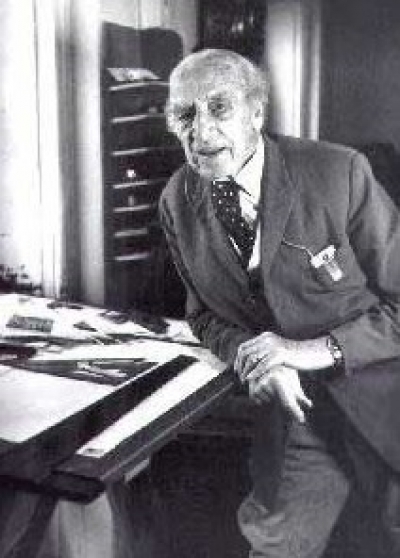
SIR CLOUGH WILLIAMS - ELLIS.
( 1883 - 1978 )
Williams - Ellis' architectural fantasy was originally funded after the restoration of the near derelict, former mansion house, Aber Ia, originally built in the 1850's, which Williams - Ellis transformed into a hotel.
The 14 room, Portmeirion Hotel was opened to the public during the Easter weekend of 1926.
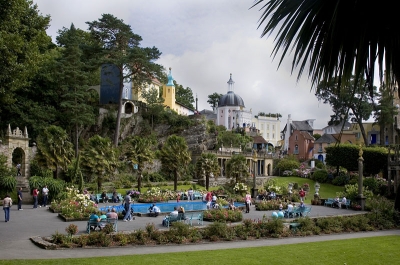
CENTRAL PLAZZA, PORTMEIRION.
Image courtesy of MichaelMaggs, wikimedia commons.
During the 1930's the village was a magnet for prominent artists, writers and poets of the day, all of whom found inspiration in the village's unique and graceful setting. No other hotel in Wales can boast such a fine array of prominent guests, including George Bernard Shaw, H.G Wells, Dylan Thomas and Noel Coward to mention but a few.
In 1967 the village was used as the location and recording of the popular television series, The Prisoner * starring Patrick McGoohan, from which the village now has a lasting legacy.
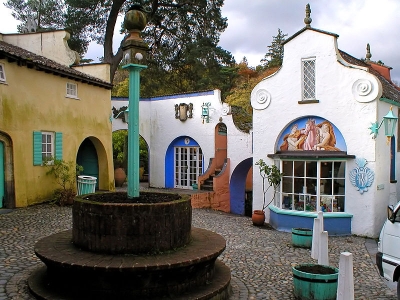
BATTERY SQUARE, PORTMEIRION.
Today the grade II listed, Italianate village sits on 70 acres of sub tropical gardens and woodland which is home to a fine collection of Rhodedendron species, much of which was originally developed by it's previous owner, ornithologist and Himilayan tree expert, George Henry Caton Haigh.
The village houses an array of many, brightly coloured and lovingly restored, Italianate and Mediterranean style buildings set amongst manicured gardens depicting rare plants and statues. Many of the buildings are now rented out as self catering holiday cottages, or used as shops, coffee houses or restaurants for the use of it's many visitors.
The whole is set in an area of stunning, natural beauty on the banks of the River Dwyryd estuary, which sports beautiful, white sandy beaches and views out across to the hills and valleys of the Welsh countryside, beyond.
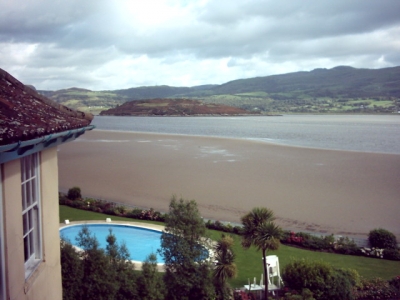
THE RIVER DWYRYD ESTUARY.
Portmeirion Village is owned by the Clough Williams - Ellis Foundation, a charitable trust and managed by Portmeirion Ltd. it is also home to a retail outlet of the world famous pottery of the same name **, and to it's newest attraction, the 11 room Castell Deudraeth Hotel, of which Williams - Ellis had strived to buy and restore as part of his estate since the early 1930's, but which has only been remodelled into a hotel since 2001.
The village also has a free, audio - video room which has half hourly showings of the history and building of the village.
Books and DVD's of the building and history of the village as well as the story of the recording of the Prisoner can be obtained from one of it's three gift shops.
Portmeirion also has four locations licensed for civil weddings, as well as halls for evening parties and restaurants for dinner parties.
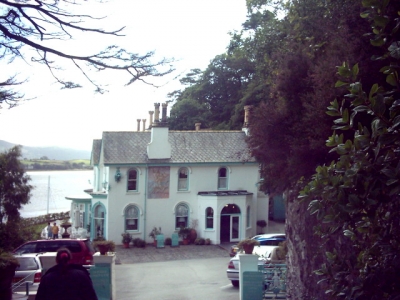
THE PORTMEIRION HOTEL.
The village and grounds are open to the public every day of the year, except Christmas Day, from 09.00 until 19.30.
Although there are many steep hills and steps throughout the village and it's grounds, there is a disabled access plan and electric buggies that can pick people up who have ventured too far into it's interior, or have trouble managing it's hilly paths.
Children are welcome with child prices from £4.00
Admission is only permitted to guide dogs.
There are several types of admission charges, from a standard adult charge of £8.00, to a variety of family packages.There are also concession charges from £6.50.
Admission to the village is half price after 15.30.
The village is served by an adjoining, large car and coach park.
* The Prisoner ran for 17 episodes on British television from September 1967 until February 1968
** Portmeirion Pottery is a Stoke - on - Trent based company founded in 1960 by Williams - Ellis' daughter , Susan.
TELEPHONE: 01766 770000
POST CODE: LL48 6ER.
HOTELS AND VILLAGE WEBSITE.
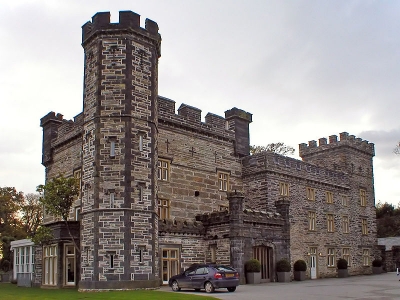
CASTELL DEUDRAETH HOTEL.
Other Wales articles by the same author -