How To Use Trello — A Step-by-Step Guide to Managing Projects Using Trello
Project ManagementHow To Use Trello — A Step-by-Step Guide to Managing Projects Using Trello
Sara Altschule
Organizing projects sounds great... until you have to sit down and do it. The overwhelm can get real, and frankly, you'd rather take a nap.
If that's you, then it sounds like you need a new project management software. That's where Trello steps in.
Trello makes managing projects so simple, you can probably teach your grandparents how to use it! With that said, even using Trello for beginners is easy as one-two-three.
Learning how to use Trello like a pro doesn't take much. In fact, you'll most likely get it down by the time you’re done reading this article.
Let's take a look at how to use Trello effectively so that managing your projects can be a breeze.
- What is Trello?
- Trello boards — Everything you need to know about them
- Trello Teams
- Collaborate in Trello
- Trello Power ups
- Trello Integrations and add-ons
- Trello shortcuts
- Consider These Top Trello Alternatives
What is Trello?
Trello is a project management software designed to make your life easier. If you're more of a visual person, then you'll love Trello because it allows you to see your projects.
Trello consists of boards, lists, and cards that make organizing your tasks simple and fun. It's flexible and lets you rearrange and prioritize your to-do list.
You can even invite your team, making working together easier.
By just a glance, you'll be able to know who's working on what and what work still needs to get done.
When using Trello, you can expect more productivity from yourself or your team.
What is Trello and why should you use it?
What is Trello good for?
To put it simply, Trello is a life-hacking app. You'll benefit from it if you work best seeing all of your projects laid out right in front of you.
It makes organizing easy and is visually appealing. Once you get used to using it, you can have a lot of fun if you have a creative side.
Trello is customizable, so you can choose a background for all of your boards and add covers to your cards.
If you've been looking for a better way to organize your life, looking into Trello is definitely worth it. Not only is it beneficial for business, but personal tasks too.
What is Trello good for?
If you're thinking about starting or are already getting started with Trello, you might be asking yourself:
What's so great about it?
6 unbeatable benefits to using Trello:
- Visually appealing - Unlike using a boring tool like Google Sheets, Trello is laid out in a more aesthetic manner.
- Easy to use - You don’t need to know programming to use Trello and its dynamic features, all the features are laid out in a straightforward system.
- Organization - They don’t call it a project management software for nothing! Trello is excellent for keeping your project organized every step of the way.
- Productivity - Without organization, productivity would tank, so what better way to stay productive than with a streamline organization tool?
- Accountability - Keeping your project on track with Trello allows you to track the project, and make sure every step gets executed along the way.
- Customization - Trello’s customization ability goes a lot further than just colors and descriptions, you can also integrate other apps (more on that later though…)
What is Trello used for?
Use Trello for:
- Track - In combination with Trello’s add-ons, cards, and lists, users can track progress on projects with checklists, attachments, comments, and moving cards through personalized lists.
- Store - Besides organizing and tracking a project, you can also use Trello boards to store projectsand attachments on your cards.
- Share - While you don’t need a team to take advantage of Trello, Trello pairs well with teams to keep everyone on top of assignments.
- Discuss - It’s primary use may not be a chatting app, but its features, such as comments, make it easy to talk with peers.
How much does Trello cost?
Let's cut to the chase:
Is Trello for free?
Good question! When getting started with Trello, you have three options to choose from: Free, Business Class, and Enterprise.
Business Class is $9.99 per month, and Enterprise is $20.83 per month.
When deciding between the three, the choice depends on the reason you're using Trello.
If you're using it for personal use, the free option can definitely work for you. You'll get unlimited boards, cards, lists, and more. If you’re managing just yourself or a small team and don’t need many special features, the free version will do just fine.
If you want to use Trello for business, Business Class or Enterprise will be your best options. Both come with unlimited team boards, custom backgrounds and stickers, better admin and security features, and more.
However, Enterprise is the better choice if you're concerned about Trello privacy and security on your account and have a larger team.
Trello boards — Everything you need to know about them
A Trello board is where you'll organize a project using lists and cards. Boards make it easy for you to view your whole project at a glance.
Steps to create a Trello board
Now that we know more about Trello — let's get into how to use Trello. First, let's start with how to create a Trello board.
Create the board
Here are the step-by-step instructions to create a board in Trello:
Step 1. Start at the home page. Click the plus sign located near the top right corner.
Step 2. Click on "Create Board."
Step 3. Once you create the board, you're going to need to add a board title. You'll also choose if you want to add a team or not, whether it's a private or public board, and the background.
Step 4. Press "Create Board."
How to delete a Trello board:
To close a Trello board, go to the sidebar menu and then click "More." Scroll down to "Close Board."
Once you close the board, a screen will pop up and ask if you want to permanently close the board.
Build lists
Lists help you keep track of all of your activities. To help give you an idea of how lists work effectively, they're usually separated into three main categories: to-do, in progress, and done.
However, if you have a better method that works for you, or if you want to add to those three sections, feel free to do so! How you name and organize your lists will depend on your reason for using Trello.
For example, you can also add sections like "Ideas" or "Ready for Review." "Ideas" can be used before "To-Do" and "Ready for Review" can go between "In Progress" and "Done."
Here are the steps to create a list in Trello:
Step 1: Click where it says: "Add another list."
Step 2: Type in the list title.
Step 3: Click "Add List."
Add Cards
Cards allow you to know more about each task. They include details such as the description, activity, members, labels, checklist, due date, and attachments.
Create a card for every task you need to get done. You can update and customize each card to your heart's content as it moves through your list and reaches completion.
Here are the steps you'll take to add a card on Trello:
Step 1: Click "Add a card."
Step 2: Type in the title you want for the card.
Step 3: Press "Add Card."
How to delete a Trello card:
To delete a Trello card, you first need to archive it. Once you archive it, Trello will give you an option to delete it.
Card Descriptions
Card descriptions are great, especially if you're using a team board!
Let's pretend you're assigning a task to another team member. To make the task easier, you'll type everything they need to know in the description.
Adding all the details about the task in the description helps boost productivity, which means you won't have to write as many emails and set up as many meetings. I'd say that's a win for everybody!
If you're using Trello for personal use, you can write whatever helps you most in the description. For example, if the card is named "grocery list," the list would be in the description.
Activity
Each card has an activity section where you and your team will be able to keep track of your work.
The activity lets you know if someone leaves a comment, if the card moves to another list, if someone adds attachments, and more.
You can also track the activity for the entire board. Simply click on the menu and scroll down to do this.
The activity feature is perfect for making sure you don’t miss a beat with your team.
Add Details
Trello cards allow you to add as many details as you want.
If you look at the right side of a card, you'll notice it has a few options on what you can add:
- Members - Assign members to each task.
- Labels - Change the label color of each card to help with your board’s visual organization or create a label name.
- Checklist - Create lists within the card to check-off checkpoints throughout the task.
- Due date - Assign due dates to create a timeline for you or your team to complete a task.
- Attachment - Attach any files that are related to the card’s purpose, such as images or documents.
- Cover - Covers are used for even more visual organization. You can change covers to images or colors.
Each detail you can add can help you further enhance the organization of your Trello cards.
How many boards can you create on Trello?
You can create unlimited personal boards on Trello.
However, keep in mind that if you're using the free version, you can only use up to ten team boards.
If you want unlimited team boards, your best option would be to use Business Class or Enterprise.
You can also start with the free version, and as your team grows, upgrade to one of the paid versions.
Who can see your Trello boards?
When creating a Trello board, you'll have three different options on its visibility: private, team, or public.
If you choose to create a private board, you'll be the only one who can view or edit it unless you add another member.
A team board is visible and editable by anyone on the team. However, an admin can change the settings and limit members from joining or editing the board.
Public boards are visible to anyone on the internet, even if they don't have a Trello account. They can find the board if they search for it through a search engine. However, only members of the board can edit it.
Personal vs Team Boards
There are three different types of Trello boards: personal boards, free team boards, and Business Class or Enterprise boards.
All Trello boards can be private or public.
Anyone with a Trello account can create unlimited personal boards. Personal boards are best for individuals who work alone, or who have a small group of associates.
Trello teams can use up to ten free team boards. Free team boards are similar to personal boards, except they're typically for larger projects and multiple members.
Like previously mentioned, if you need to use more than ten team boards, you'll need to use Business Class or Enterprise.
Both come with unlimited team boards and have many more benefits, such as board collections and team board templates.
Create template Trello boards
You can find Trello templates on your Trello homepage or by clicking "Start with a Template" when creating a new board.
Once clicking, you'll next see a gallery of templates that have worked for others who use Trello. There are all kinds of categories for you to choose from, like education and marketing.
If you find a template that you like while browsing, you can learn more about it by clicking on it. To use the template, all you need to do is click "Use Template."
But what if you want to create your own Trello templates?
No worries, it's super easy! Just keep in mind that the board needs to be public.
Here's how to create Trello templates:
Step 1: Choose the Trello board that you want to turn into a template.
Step 2: Open the board menu by pressing "Show Menu."
Step 3: Click "More."
Step 4: Select "Make Template."
And that's it! You can now add a description to "About This Template" so that others who want to use it can learn more about it.
Inspiration template boards
If you're looking for template board inspiration, you're in luck!
First, go to Trello's homepage and click where it says "Templates."
You'll be able to browse through all kinds of sample Trello boards. You can make it easier by choosing a category or by looking at all the "New and Notable Templates."
Trello board pro-tips
Now that we have most of the basics down, it's time to learn how to use Trello like a pro.
There are a lot of cool things that you can do with Trello. If you love creativity and convenience, then you're going to love this next section!
Change background
To change the background on a Trello board, click on the menu, and select "Change Background."
If you're using Trello for free, you can choose between their selection of colors or photos. Their photos are from Unsplash, so you'll have a lot of options.
You can choose a custom background if you're using Business Class or Enterprise.
Add stickers
You can use stickers to add more fun and customization to your cards. They're also excellent for helping with communication between you and your team.
To add a sticker to a card, open the menu and click where it says "Stickers."
If you're using Trello for free, you'll have twelve general stickers. Business Class and Enterprise both give you access to custom stickers, Taco Pack, and Pete the Computer.
Search Trello boards
Trello makes searching for cards easy by allowing you to search through all of your boards.
All you have to do is type in a keyword into the search bar at the top of Trello's page. You'll notice that the most recent cards that you've made will show up first.
You can also use search operators to help you locate specific cards.
Here are some convenient search operators and how to use them:
- member: - Brings up a member and the cards that they're working on. Just type in their name after the colon. You can also type in @ before their name.
- @me - You'll search all of the cards you're on across all boards.
- board: - Searches specific boards. Type in a keyword or board name after the colon.
- list: - Type in a list keyword after the colon, and the search will bring up relevant lists.
- has:attachments - Searches cards with attachments. You can also use has:description, has:members, has:cover, and has:stickers.
- due:day - Brings up cards due that day. You can do the same with due:week, due:month, due:overdue, due:complete, and due:incomplete.
- description:, checklist:, comment:, and name: - Type in a keyword after the colon, and cards with matching descriptions, checklists, comments, and names will appear.
You can also search the cards you're on across all boards by clicking on your photo at the top right corner. A menu will drop down, and you'll click where it says "Cards."
Create Bulk Cards
To create bulk cards, you're going to want to use a power-up called Card Repeater.
First, you'll click the sidebar menu. Go down to "Power-Ups" and then search for "Card Repeater."
Add it, and it will appear in your menu.
Make sure to keep in mind that if you're a free Trello user, then you'll only have access to one power-up per board. You can upgrade to Business Class if you need more.
Once you have Card Repeater added, click on the card that you want to make in bulk.
On the side of the card, you'll see "Repeat" under the “Power-Ups” section. Click on it and then choose if you want repeats to go out weekly, monthly, or yearly. You'll also be able to choose the time, day, and list that you want the card to repeat on.
Develop Cards through email
What is the best way to use Trello? Glad you asked!
Did you know that you can create cards by email?
First, go to the board that you want to use to create cards through email. Go to the menu on the sidebar and select "More." Click on "Email-to-board Settings."
Once you click that, you can choose which list you want the cards to appear on. On the menu, you'll see the email address that you'll email to when you want to add a card.
You can press "Email me this address," and Trello will send it to you in a snap. From there, it'll be safe in your inbox, and all you'll need to do is reply to it when you want to add a card.
Here's what you need to know when creating a card through email:
- The subject line is the card title
- The body of the email is the card description
- Attach anything you want to be attached to the card
- Add members by typing @ and then their username. You can type their username in the subject line or body. You can also add members by using their Trello email addresses as a "CC" address.
- To add labels, type: #labelname, #labelcolor, and #labelnumber to the subject line.
And that's it! Pretty cool, right?
Trello Teams
Now that you're a pro at Trello, it's time to start getting productive and organize a team!
What are teams?
On Trello, teams make organizing members and boards easier. Whether it's for work or fun, you can create a Trello teamfor anything! There's also no end to how many Trello teams you can start.
If you're using Trello for free, you can use up to ten team boards. To use more than that, you'll need Business Class or Enterprise.
Create a Trello team
Here's a step-by-step guide on how to create a Trello team:
Step 1: Click the plus sign near the top right corner of Trello.
Step 2: Go down and select "Create Team" or "Create Business Team."
Step 3: Name your team whatever you'd like, choose the "Team Type," and then enter your team's description (optional).
Step 4: Hit "Continue."
Invite team members/removing team members
You can add or remove team members on the member's tab on the team page.
If you want to add members, all you need to do is type in their name or email into the box located under "Team Members." Once finished, click "Invite to Team."
To remove team members, click "Remove," which is next to their photo on the team page.
Move boards to a team
Moving a Trello board to a team is super easy!
Make sure you're on the board that you want to use for the team. Click at the top of the page where it says "Personal."
A menu will drop down, and you can select the team you want to add to the board. That's it!
If you want to move a Trello board to a different team, you can also click the menu on the sidebar, go to "More," then click on "Settings." Press "Change Team," and you're all set!
Manage visibility
To manage the visibility of a team, go to the Settings tab on the member page. There, you'll be able to change the settings to private or public.
Change user permissions
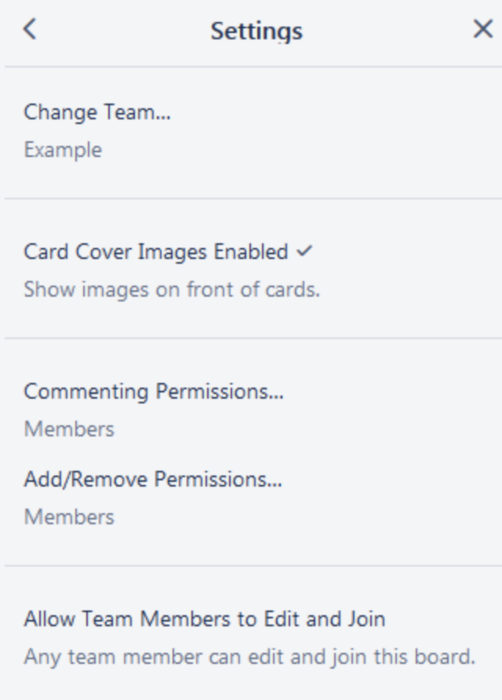
If you want to change user permissions on a team board, go to the menu on the sidebar of the board. Click on "More," and then "Settings."
Below, you'll see "Commenting Permissions" and "Add/Remove Permissions."
Commenting Permissions is where you'll choose who can comment on a team board. You have a few options:
- Disabled - No comments allowed.
- Members - Only admins and members are allowed to comment.
- Members and Observers - Admins, members, and observers are allowed to comment.
- Team members - Admins, members, observers, and team members are allowed to comment.
- Public members - Any Trello member is allowed to comment.
On the Add/Remove Permissions section, you can decide who's allowed to add members to a Trello board. There are two choices: admin only, or all members.
Collaborate in Trello
One of the best things about Trello is that it makes collaboration easy. A Trello board can tell you everything you need to know by just a glance.
Comments
We can all agree that communication is key. Utilizing the comments on a card can make all the difference for your team.
If you or someone else is working on a card, it can help to leave comments so that others can know the status of your work. You can even ask your team to look at your task and ask for feedback.
Mentions
If you want to talk to someone specifically in the comments, you can mention them by putting an "@" before their name. They'll get a notification, which will take them directly to your mention.
To mention everyone on a card or board, just type @card or @board.
Labels
Labels are great for categorizing cards using colors or names. An active label will show on the front of a card — making it easier for you to stay on top of your work.
You'll have ten colors to pick from, or you can use the colorless option and name the label instead.
If you really love organizing, you can choose both a color and a name for the label.
You can add a label to a card by opening it and pressing "Labels" on the right-hand side.
From there, you'll be able to decide whether you want color, no color, or a name for the label.
Trello Power Ups
As if Trello wasn't already easy and convenient to use, it also has power-ups.
Using the right power-ups can really change the game for your Trello boards. With that said, let's get into what they are, and what's so great about them.
What are Trello power-ups?
Power-Ups let you add even more features to your board. But that's not it! With power-ups, you can also integrate your favorite apps with Trello.
Basically, power-ups make running a Trello board even better. If Trello didn't fit your needs before, using power-ups can fix that.
Are power ups free in Trello?
If you're using the free version of Trello, you can use up to one power-up per board. To get unlimited power-ups, you'll need to get Business Class or Enterprise.
Best Trello power ups
So just what can a power-up do? Let's learn about some of the best Trello Power-Ups, and what makes them so amazing.
- Boards Connected and Synced with Unito - The Unito Power-Up is excellent because it lets you sync multiple boards together. Unito takes the stress out of projects because you can track everything in one place.
- Card Repeater - Creating a card shouldn't be a task in itself, and this power-up makes sure of that by taking one more chore off your plate. If you have a card that you use repeatedly, Card Repeater makes it easier for you by repeating that card daily, weekly, monthly, or yearly.
- Google Drive - With the Google Drive Power-Up, you can attach Google Drive links to your card.
- Calendar - Calendar is one of the most popular power-ups because it allows you to view all of your due dates on one huge Trello calendar. It makes scheduling easy by letting you click on your assignments, see them in-depth, and move them around.
- Custom Fields - This power-up gives your cards more context. With Custom Fields, you can add start and end dates, checkboxes, contact info, and so much more! If you're someone who loves detail, this power-up is perfect for you.
- Voting - Want to add some fun to your board? The Voting Power-Up will make sure of that! Whether you and your team are voting on a new project or deciding on a place to meet at for lunch, this power-up will be sure to add enjoyment to your workflow.
- Map - The Map Power-Up allows you to add locations to your cards and see them in map-view. It's perfect for you if you're always on the go!
- Giphy - Giphy lets you add GIFs to your cards. Need we say more?
- Pomorello - There's no doubt that the Pomodoro Technique is brilliant. With the Pomorello Power-Up, you can add the perfect balance of work and breaks to your day.
- Manny - Say goodbye to the days of wasting minutes moving your cards one at a time. Manny allows you to select and move many cards all at once!
Trello Integrations & add-ons
One of the most convenient features of Trello is that it allows you to integrate with and add-on other platforms. With that said, let's explore what Trello integrates with, and which are the best options for your projects.
What does Trello integrate with?
Trello integrates with apps like Slack, Salesforce, Evernote, and so much more. Integrating can be helpful for teams, as it meets their unique business needs.
Best Trello integrations
Now that you know more about Trello integrations, let's look at some of the best:
- Slack - Slack and Trello are two team & project management tools that we love, and thankfully, they integrate together like peanut butter and jelly. Slack is great for communicating messages to your team, while Trello can connect to your Slack workspace with automation and more ease-of-use.
- InVision - This integration allows teams to paste InVision links to Trello cards giving members a preview of their work.
- Bridge24 - Bridge24 is a professional reporting and exporting tool for Trello.
- Jira - The Jira and Trello duo allows users to have quick access to their Jira issues from their board to make collaborations between the software fast and easy.
- Google Drive - Chances are most online teams are using Google Drive to work together on projects. This integration lets Trello users attach and use Drive files on their Trello cards.
- Adobe XD - The Adobe XD integrations are great for connecting artboards and layers straight to your Trello card for quick previews and edits.
- Zapier - Integrating Zapier to your Trello boards helps save members time and endless headaches with quick automation.
Trello shortcuts
Trello shortcuts can save a lot of time and boost productivity. Here are some helpful keyboard shortcuts that you need if you like working fast:
- / - Will put the cursor in the search box.
- ? - Opens shortcut page.
- @ - Autocomplete members.
- # - Autocomplete labels.
- B - Opens the board menu in the header.
- C - Archive a card.
- D - Opens the due date picker for a card.
- E - Will open quick edit mode.
- F - Opens a card filter menu.
- L - Opens a pop-over of the labels.
- M - Opens the add/remove members menu.
- N - Inserts a new card.
- Q - Will filter the cards assigned to you.
- S - Watch or unwatch a card.
- T - Opens a card to edit the title.
- V - Will add/remove your vote on a card.
- W - Will collapse or expand the sidebar menu.
- X - Clears all filters.
- Esc - Will close out a menu or cancel editing.
- Enter - Opens a selected card.
- Space - Assigns or unassigns a card to you.
Consider These Top Trello Alternatives
Let's be honest here:
Trello doesn't always meet everyone's needs. And they’re definitely not the be-all-end-all of project management software.
Let's explore some reasons why you might not like Trello and some alternatives.
Reasons someone might switch
Just like anything else, Trello isn't perfect. Here are some cons that users experience with Trello:
- Storage is limited
- Not ideal for larger projects
- Too many cards can be overwhelming
- Limited Power-Ups on the free version
- Customer service needs improvement
Top alternatives for Trello
Basecamp - Basecamp is a popular project management software like Trello. According to its users, its customer service and reporting are significantly better than Trello's.
Price: $99/month, flat.
Smartsheet - Smartsheet is an upper-level spreadsheet tool. It has been rated better than Trello when it comes to workflow management features and reports.
Prices: Individual - $14/month, Business - $25/month, Enterprise and Premier - custom.
Kanbanchi- Kanbanchi is an excellent alternative for Trello. It has good reviews on customer service, workflow management features, reports, and customization.
Prices: Starter - $7.95/month, Professional - $19.97/month, Enterprise - $34.97/month.
Airtable - Airtable is another great Trello alternative. According to its reviews, it has Trello beat in customer service, workflow management, customization, and reports.
Prices: Free, Plus - $10/month, Pro - $20/month, Enterprise - custom.
Freeter - Freeter isn't as popular as other project management software, but it gets the job done. It has better reports and customization than Trello.
Price: $29/no subscription.
Conclusion
Now that you've read this Trello tutorial, it's time to give Trello a try! Feel free to come back to this article if you ever find yourself stuck or have questions.
