How to Raise Ducks
EducationHow to Raise Ducks

Ducks are often kept as pets, or to produce eggs for eating, or the ducks themselves are raised for meat. Some people even keep ducks to control ticks and bugs in their yard.
There are many different breeds of ducks so a person needs to select the right breed for their purposes, and then needs to learn more about the basics of duck care and how to raise ducks.
Buying Ducks
Ducks can be purchases as hatching eggs, ducklings, or as mature ducks. For a new person starting with a mature pair of bonded ducks can be the best thing rather than starting with eggs. Eggs need to be incubated for 28 days and you might have more drakes (males) than you have ducks (females). As well incubation is a tricky thing, not all eggs will survive.
Starting with ducklings can be tough, in that they must be kept warm. The benefit of starting with eggs or ducklings, is that they will bond to you more than if you start with a mature pair of ducks.
You can buy ducks from a hatchery, bird auction, or other source. If you do not know where to look for ducks, ask at your local livestock feed store. If you are buying older ducks, make sure they are healthy.
Common Breeds of Ducks
The most common breeds of duck for meat are the Pekin, Muscovy, and Rouen, Ducks. The most common duck breeds for egg laying are the Indian Runner and the Khaki Campbell. Other duck breeds such as the Call duck (also used by hunters), and the Wood duck, are often kept as ornamental pets.
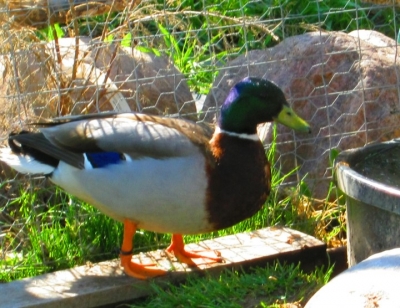
Above is a male call duck - you note the enclosure has stucco wire and chicken wire, this is to keep the tiny ducklings in and predators out!
Select the breed according to your plans, and research specific behaviors of each breed. Some keepers find Muscovies to be prone to flying away and often clip one, or both, wings.
Water
Ducks are waterfowl, they need a place to swim. This does not have to be a huge pond, but can be something as small as a fed trough or feed bowl filled with water. It can even be a plastic child's swimming pool. Ducks will often use their swimming water to moisten their food so it will get dirty quick. In the winter the water should be removed because they will still want to go into it and if its near freezing, they can freeze their feet when they get out of the water. They still need drinking water, of course.
Feeding
You can buy commercially prepared duck food. If you have ducklings you cannot use food for other birds as it often has medication in it which is deadly to ducklings, instead you must use duckling starter.
Your ducks will also eat bugs and a few plants, such as dandelions, with Muscovy ducks being especially noted for being excellent foragers.
Ducks eat by soaking their food in water, either the pond, puddle, or water bowl.
Shelter
Ducks quite enjoy bad weather, such as rain, however they still should have a proper shelter, particularly if they are nesting, or if you want to keep them overwinter. The shelter itself does not need to be heated but the door way must face away from prevailing winds. Even an old dog house will work good for a duck shelter.
You may want to have your ducks loose in your yard if predators are not a threat, or caged. Most people will cage them when they are nesting, and may open the door of the cage and let the birds roam the yard at other times during the day (caging them at night when most predators are active).
Breeding Ducks
You should have no more than two females per male, and not have more males than you have females. Female ducks are called ducks, they often have different colors than males, being more drab than males, and females are the ones that “quack”. Males are called drakes, they moult feathers once a year so may appear more like females in the winter, they do not have a loud quack, but can make other sounds.
The female will lay several eggs before deciding to sit on them. Or you may remove the eggs and store them for incubation. It takes 28 days for a duck egg to hatch from the time it is incubated. Ducklings grow very quickly, but you should note they cannot swim right away, and should be kept from water more than an inch deep for the first week. Their downy feathers can become water logged and they will drown. After a week they will have doubled in size and can have slightly deeper water, and can have regular water at three weeks of age. When giving water for ducklings be sure they can get in and out of the water source on their own. A shallow kitten litter box works well for the first 3 weeks.
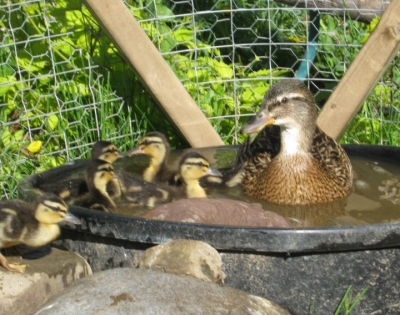
Above - a female Call duck with her ducklings at 3 weeks of age.
As mentioned earlier it is important that ducklings only be fed duckling food, not food for young chickens. Note that young duckings are very vulnerable to predators such as hawks, so need to be kept protected.