How to Control a Feral Cat Population
EducationHow to Control a Feral Cat Population

Feral cats can be a real problem, their numbers quickly increase, and they spread diseases, and parasites, to the general cat population. Controlling feral cat populations may seem like a daunting task but it can be done.
Feral cats are technically any cat that had an owner but was either lost, or abandoned, at some point and is now behaving independently much like a “wild” cat. Kittens born to feral cats are also referred to as “feral” although they may be truly wild in behavior, having never been touched by a human.
Controlling a feral cat population starts by identifying the problem, and being certain the cats are truly feral rather than cats whose owners are negligent and leave them out all the time, or that they are strays. This can be done in one of several ways, the easiest may be to photograph the cats and then canvass the neighborhood to see if anyone claims ownership of certain cats.
Find out the laws in your area, most areas have adopted cat bylaws restricting cats to their owners home and yard, any cat off the property is often considered a stray, however to be fair to the owners of these cats if you ask around you may find they do have owners and are not feral, or strays, at all.
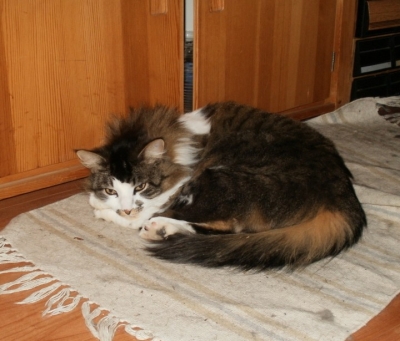
One of the author's cats, formerly feral.
Contact your local animal shelter, leave descriptions of all the cats with them. If they have a LOST CAT file they can check it against your description. Most shelters only keep lost cat reports for six months. If the feral cats have been around longer than that chances are you are fine to proceed with treating them as we shall discuss.
It is a good idea to contact your local animal shelter as their involvement will be key. Or you may be working with, or for, an animal shelter already, making the success of this venture even more possible. If you do not have the cooperation of an animal shelter, you will need space in your home to proceed.
Trap the Cats
The cats must be caught. If allowed to continue living as ferals the cat population will sky rocket. If the cats are truly feral they will be impossible to catch by hand, however one might attempt to lure a few into being caught by offering canned food. If caught the cats should immediately be placed into a crate, or cat kennel.
Cat traps may be rented, or purchased. Some veterinarians, shelters, or bylaw departments, offer cat traps for rent. They can be purchased from a livestock feed supply store, or some pet supply stores.
Trapped cats should be taken to a veterinarian, or animal shelter, to be scanned for a microchip which may be traceable to an owner.
At this point decisions have to be made. Either the cats life will be spared, or it will be euthanized. When dealing with a shelter, they may still have to hold the cat for a minimum of 72 hours to see if an owner can be found. If the cats life is to be spared it may also require a 72 hour wait before proceeding – and then can be spayed or neutered, vaccinated, wormed, and either released, or socialized and adopted out.
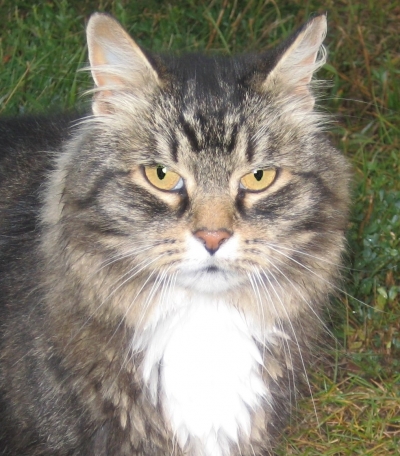
SNR – Spay Neuter Release – Is one way of controlling the feral population in an area. Fixed cats cannot reproduce, and will colonize an area, keeping new cats out. When this is done the cats usually have their ears cut in a way that will indicate that they have been trapped, and fixed already - called ear tipping. When feral cats are removed from an area, other cats will eventually claim it and the problem can continue.
Some animal rescue groups adopt out spayed, or neutered, feral cats as farm cats – the cats still should be fed and cared for in this situation. It may be a lower cost, or free, to adopt such a cat.
To socialize a feral cat they should be confined in a small room, such as a bathroom. The best success will be with kittens, or feral cats that had owners previously, but even the wild born feral cat is tameable (author owns four such cats).
The way to a cats heart is through its stomach. It should have a litter box, dry food, and water, in the room at all times, but canned food should only be given when somebody is with it. In this way the cat learns that people are non threatening and associates them with good things – food! Somebody who wishes to tame a feral cat must plan on visiting it several times a day, each time with the offering of a small amount of canned food.
Young kittens who behave wildly may be confined to a cage to make them easy to catch, and should be forcibly held periodically throughout the day. Older cats will put up more fuss if forcibly held and should be allowed to build up their trust before they are held.
The main thing is to get these cats spayed or neutered, so the feral population is limited.
Be aware in most areas it is illegal to poison, shoot, or otherwise kill feral and stray cats, as it is the responsibility of the local shelter to euthanize the animals humanely if that is what is to be done with them – and again only after a waiting period has passed in which the animals were reported found.
Other Ideas
Not everyone is able to trap, and spay or neuter, every feral cat. If this cannot be done catching as many as possible will help make a dent in the problem, and is better than ignoring the situation altogether. Kittens are often the easiest to catch, and rehome. Spaying all the females possible will prevent more kittens from being born.
If the cats are chased away, no solution has really been reached, as the problem is simply moved on to another. The key is to act as soon as a feral cat population starts rather than to wait until it becomes a huge problem.
Futher Reading
How to Get Rid of an Unwanted Cat