Horse Breeding, How to Pick the Right Stud for Your Mare
EducationHorse Breeding, How to Pick the Right Stud for Your Mare

If you have a mare and are thinking of breeding her, you need to know it is not a matter of selecting the prettiest stallion. You need to do some research to be sure the stallion to pick is a good match for your mare. Before you even get to that you must be certain your mare is worth breeding, there are currently too many horses for the market and many are suffering as a result.
Should you Breed your Mare?
Your mare should be at least four years of age before being bred, although they can be bred sooner this is stressful on them, stunts their growth, and may even result in the mare not being able to deliver or produce milk.
Your mare should be a registered purebred horse who has attended shows in both halter and performance to prove she is worth breeding. At the very least she should have earned several first place finishes when shown against her peers of the same breed.
You should have a barn with a foaling stall, and the finances to pay for a veterinarian should any problems arise. The mare will need additional feed throughout her pregnancy which should also be budgeted for.
A saying in the horse breeding industry is “Breed the best to the best, and hope for the best”. Never breed a substandard mare, or breed to a substandard stallion.
Rate Your Mare
Have a look at your mare, what are her strengths, what are her weaknesses? You are looking at genetic factors only. Does she have a good hip, what about her topline, are her legs straight? Determine her weaknesses, you may even recall things judges have said about her in the past.
Look at her pedigree. Has she been line bred? If so is this something you want to continue? If your mare has only been shown in halter classes, you can look at the pedigree to determine what “type” of horse she was bred to be. Was she bred for western performance, speed, or confirmation?
Note the other horses in her pedigree, what where their show records like, what were they best known for. If you are breeding a horse that was bred for a purpose (let us say a Quarter Horse bred to race) but was not used for that purpose, you may be better off continuing to breed for that same goal rather than to breed her to a different “type” of Quarter Horse (say one bred for halter) as you will produce a foal that is somewhere in between, and possibly good for neither.
Look at the Stallions Standing at Stud
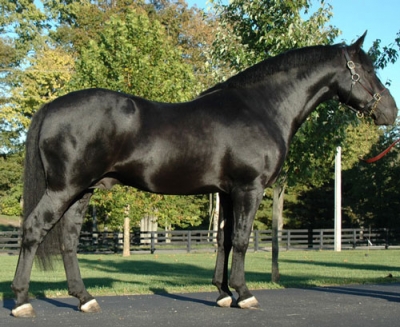
photo source - Irish Draught Stallion

Next you will want to consider what stallions are available to you that are within your price range. Some stallions are offered at “Private Treaty” meaning they will not be put to “just any mare” and your mare must be of top quality (earned championship titles).
Look for a stallion that has features that compliment your mare. If your mare has a weak hip, for example, then look for a stallion that has a strong hip. Do not fall for "color". In the past (as after the movie The Black Stallion) people focused on breeding black Arabian horses, and selected breeding horses based on color, in the end this resulted in several poorly bred, but "black" Arabian horses.
As mentioned above, select a stallion whose pedigree compliments the mare.
Look at a stallions past foals. Are they correct? Do they mature well? Do they have any show or performance records you can see? Compare the quality of your mare to the quality of mares the stallion has been bred to. A stallion that can produce good foals when bred to mediocre mares is a far more interesting stud prospect than one who has produced average foals when bred to top mares. You may specifically want to look at foals produced when the stallion was bred to mares whose bloodlines are similar to your mare's.
Some lines cross better than others. The best way of telling if your mare will cross well with a particular stallion is by looking at foals produced when he was bred to a mare closely related to yours.
If you have bred your mare to a particular twice and been disappointed both times, do not breed to him again, select a completely different bloodline, or do not breed your mare at all.
The stallion should be no more than one hand taller than the mare. This is particularly important in miniature horses as many minis have great trouble foaling big foals.
Discuss stud fee, boarding fee, and mare care (most mares stay at the stud farm for breeding). Insist on a live foal guarantee, and get it in writing.
Never breed to a stallion that is not registered and not proven at show or in competition.
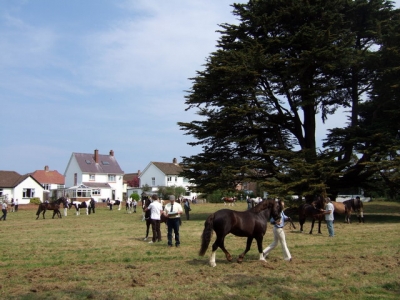
photo source - stallions at show in Wales

Summary
Have a goal in mind, have a picture of a foal in mind that you are breeding towards. You can guess what you will get from your mare, select a stud that compliments the mare. Do not simply breed a mare “because you can” or “to see what her foals will be like” this is irresponsible breeding.
Note: Although color should not be a deciding factor you should never breed a roan mare to a roan stud. Genetically 1 in 4 foals from this combination is born dead. The same occurs in white horses, and overo colored horses who are bred to horses of their same color.