Facts About the Dust Bowl
EducationFacts About the Dust Bowl

The Dust Bowl was caused by several different factors that all seemed to come together at the same time. The reasons for this disaster didn’t just happen overnight, they had been building up for at least a decade. Over planting of crops during World War I, the government said to plant more and the farmers did. After World War I things were great, the prices for crops were good and the rains came. In order to plant more crops, farmers were buying new land and equipment on credit. New technologies were developed that farmers used to tear up land even faster. The farmers didn’t rotate crops nor did they leave areas of native grasses, they just dug up everything and planted crops. Some people started saying this is all wrong. The ground is now upside down. And it was. The native grasses were now underneath and the dirt on top.
This area of the United States was primarily in the Great Plains states, from the Rocky Mountains eastward to the high plains. Early travelers called this the Great American Desert and it was even written that way on early US maps. The entire area was mainly covered in native grasses. These grasses had been there for thousands of years, keeping the soil healthy and in place.
In 1931 there was a record wheat harvest, which depressed the price of wheat. In order to make payments on land and machinery on time and to make up for the lower price of wheat, farmers had to plant more and more which meant tearing up the land further. Farmers were warned by Native American Indians and also old time cattle ranchers that had known that land for many years, not to tear up the native grasses. But the farmers had to by now and continued to plow under even more native grasslands and plant crops. Soil conservation practices had to be abandoned so that extra crops could be planted to meet payments as the price fell for wheat and other crops.
By the early 1930s the Great Depression had hit the country. And at this time a severe drought had started in the Great Plains. The rains didn’t come anymore as expected. In the high plains, the 1930s were known as the Dirty 30s.
The Soil Conservation Service described the area of the severe drought as in western Kansas, eastern Colorado, the Oklahoma panhandle and the Texas panhandle.
There were 14 severe dust storms in 1932 and in 1933 there were 38 of them reported. In 1937 there were 134 dust storms. These dust storms were called black blizzards.
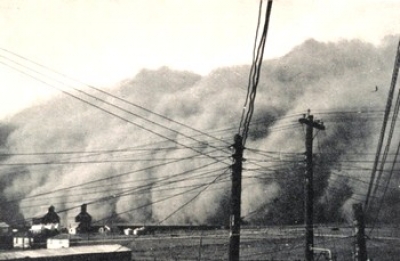
Dust storm heading into Sherman Texas April 14, 1935
By 1934, The Yearbook of Agriculture announces that 100 million acres have lost all or most of their topsoil, another 125 million acres are about to and 35 million acres cannot grow crops of any kind.
On May 9, 1934, a major dust storm started over the northern plains of Montana and the Dakotas and by night it had reached Chicago dumping an estimated 6,000 tons of dust. By the next morning the dust had reached Boston and New York where the streetlights came on at midday and cars had to use headlights. The dust cloud was 1,800 miles wide.
Sunday, April 14, 1935 was the worst dust storm, being called Black Sunday. The day after this storm, an AP reporter used the term “Dust Bowl” for the first time.

Dust storm in Stratford, Texas, April 1935
April 19, 1935 in Washington D. C., a group of senators were in a meeting about the situation in the Plains states. Bored and not paying attention, one of them looked outside and said that it is getting dark outside as the sun disappeared behind the cloud of dust that started 2,000 miles to the west five days earlier on Black Sunday.
The Soil Conservation Act of 1935 was signed into law by President Franklin D. Roosevelt on April 27, 1935. This law gave farmers money to plant native grasses, trees and certain vegetables to protect the soil from soil erosion and keep it from blowing away.
By the spring of 1935, people began to do die of what was called dust pneumonia and in 1938 Woody Guthrie wrote a song called “Dust Pneumonia Blues”.
During the dust storms, the static electricity was so bad it would short out cars leaving people stranded in the middle of these dust storms

Farm equipment buried in dirt - South Dakota 1936
By December 1935, experts had estimated that 850 million tons of topsoil had blown off of the southern plains.
About 25% of the population left the affected states and by 1940, 2.5 million people had moved out of the Plains states.
Reporter Ernie Pyle wrote, “If you would like to have your heart broken, just come out here”.
The rains came again in the fall of 1939 and with the start of World War II in 1941, the price of crops were rising. New farming and conservation techniques were learned and put into practice. In the middle 1950s another severe drought hit the same area. There were dust storms, but the lessons learned from the dirty 30s saved the area from having another Dust Bowl.
Historian Robert Worster wrote, "The ultimate meaning of the dust storms of the 1930s was that America as a whole, not just the plains, was badly out of balance with its natural environment. Unbounded optimism about the future, careless disregard of nature's limits and uncertainties, uncritical faith in Providence, devotion to self-aggrandizement - all these were national as well as regional characteristics."
© 2009 Sam Montana
Resources and helpful information
WGBH/PBS Film about the Dust Bowl
The Worst Hard Time by Timothy Egan
Historical Facts About The Great Depression