Correcting Common Problems in Your Air Conditioning Ductwork
EducationCorrecting Common Problems in Your Air Conditioning Ductwork

Most residential air conditioning systems are fairly straightforward and should follow a handful of guidelines without being designed according to industry standards. The best known of these procedures is the Air Conditioning Contractors of America (ACCA) Manual D.
Best Practices for Ductwork Runs
• Changes in airflow direction should be accomplished as infrequently and as smoothly as possible.
• The inner liner of flex duct should be pulled to its full extent to avoid the spiral “accordion” effect which causes a lot of flow resistance, or use smooth metal duct.
• Start with the size of the fan outlet/inlet connection. Use that size if the duct length is fairly short (less than 10 ft.) Increase the duct size 1 inch if the duct run is not long (less than 25 ft.) and there are few fittings (less than 3). Go up 2 inches in duct size if the duct run is long or there are many fittings. Size the wall cap or roof jack to match the final duct size.
• Seal all joints with long-lasting sealant material such as duct mastic. Some UL 181 listed tapes will work well on clean surfaces, but do not use cloth-backed tape.
The outlet connection for standard bathroom exhaust fans is usually 3 inch diameter. The better fans are 4 inch. Remote fans usually have 4, 6, or 8 inch diameter inlet or outlet connections. Smooth transition fittings should be used to change duct sizes. Odd-sized diameter duct is less common, but they are available and can make achieving the right air flow much easier.
If you are designing the duct system, when laying out duct runs and sizes, plan for air velocity of:
Supply ducts should be sized for 500 ft/min or less. To determine this velocity you need to know the amount of air supplied by your unit. It may be stamped on the label near the model and serial number or you can look it up in the owner’s manual. If all else fails you can research it online through the manufacturers website. Divide the amount of air (cubic feet per minute, CFM) by the area of the main supply trunk in square feet. Measure the metal duct, not the insulation around it; for fiberboard ductwork, which is usually an inch thick, subtract 2” from the height and width of the ductwork. Example: Air handler the supplies 1,600 CFM through a metal duct that measures 30” x 16”
1,600 CFM / ((30” x 16”)/144) = 480 ft/min < 500 ft/min; velocity is within recommended range.
(To convert the duct dimensions from square inches to square feet divide the area of the duct 144 square inches per square foot)
Return ducts should be sized for 350 ft/min.
By keeping the velocity below 500 ft/min will help keep static pressure and noise down, while keeping throw and efficiency up. Throw and efficiency have to do with how well the air is injected into the room so that it mixes well with room air. It will also keep energy cost down by keeping the motor from working too hard and maintaining the proper temperature.
General conventions for branching round ducts are:
• One 5” duct branches to two 4” ducts
• One 6” duct branches to two 5” ducts
• One 8” duct branches to two 6” ducts
Exhaust fans in the same dwelling can share a common discharge duct, but each fan must have a back-draft damper to prevent movement of air from one fan back through another.
Stamped metal grilles are inexpensive, but they are not adjustable and are inefficient. Aluminum grilles should be used where moisture will be present instead of standard painted steel. Grilles with adjustable curved blades that can direct the airflow to suit the room layout are the best choice. Grilles with a means to adjust the volume of air flow can help with balancing, but cannot limit the flow as well as volume dampers mounted in the duct branch. They can also be noisy if the are less than 50% open.
Transfer Grilles or Jump Ducts
Jump ducts are a popular method for improving the energy efficiency of homes with forced-air heating and cooling systems. They address the critical issues of equalizing air pressure in various parts of the home and of handling return air. When doors are closed, as with the case of bedrooms, it can be difficult to return enough air back to the air handling unit and create negative pressure inside the house. This would cause unconditioned air to enter the home through cracks and leaking windows or doors.
Inside the room, if more air is supplied than is returned, the air pressure in the room increases and exceeds the pressure outside it. Without balanced air pressure, energy efficiency decreases as conditioned air escapes through the building envelope, through uncontrolled routes such as windows or around electric outlets.
When return ductwork or plenums are installed, the cavities between studs and floor joist are used by attaching a piece of sheet metal to one side and using the floor joists and subfloor to complete the return. Inside walls, two studs and the layers of drywall are used and a hole is cut in the bottom plate of the wall. It a 2x4 framed wall, the area is about 0.35 square feet. If more than 125 CFM of air is supplied to the room, the return would be undersized. Return grilles have about 80% free area, so they should be larger than 3 ½ x 14 ½ or about 6 x 15. Larger rooms have holes cut between two stud cavities to increase the increase the area.
The problem with using wall and floor cavities is that they leak and can introduce humidity into the structure during the cooling season. The holes may not be cleanly cut and can compromise the wall or floor structure.
It is a fairly easy process to install a jump duct. A grille on the ceiling of the room is connected through ductwork to a grill in the hallway's ceiling. Air exits the room through the jump duct into the hallway, and then moves through the hallway to the main return duct. A transfer grille can also be installed near the ceiling to accomplish the same thing. A baffle should be installed to prevent light from leaking through. If noise and privacy are concerns, a length of six to eight feet of flexible duct will help prevent light pollution, as well as dampen noise moving between a room and the hallway. Low-cost stamped-metal grilles are typically used to provide a finished look on the ceiling. Doors should still be undercut by at least 1” as well.

Typical Jump Duct

Transfer Grille
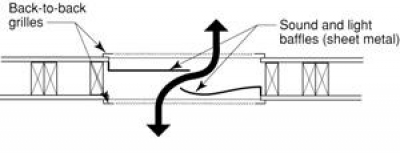
Transfer Grille (Top View)
If you are experiencing problems related to return air, such as extreme inefficiency, dampness or other comfort problems, jump ducts are worth considering. It is relatively straightforward to gain access to the space above the bedrooms and hall, and a central return can be accommodated in the main space of the house. In a few homes I inspected, the wall cavity used for a return was open to the attic and was pulling in unconditioned air year-round. Insulation and dust was also pulled into the system and reduced efficiency and reduce indoor air quality.