Corning Museum of Glass: A Tourist Destination in Corning, NY
EducationCorning Museum of Glass: A Tourist Destination in Corning, NY

History of Glassmaking: Corning Museum of Glass
Located just off the NY State I-86 at Exit 46 is the Corning Museum of Glass, heralded as the World's Largest Glass Museum. It is an ultra modern museum with much to offer tourism including shuttle buses and free ample parking. Accessible to the handicapped is provided and even a cafeteria on the site. Here is a travel destination to not be missed.
Corning Museum of Glass - Open Daily
Open daily from 9:00AM to 5:00PM with extended summer hours 'til 8:00PM (Memorial Day until Labor Day,) the history of glass-making is on display in the expansive galleries and provides the tourist with a memorable and comfortable visit. The Museum is open year-'round, closed only four days in the year (New Year's Day, Thanksgiving, and Dec. 24th - Dec. 25th. )
With a low admission fee for adults with children & teenagers under 19 admitted free, here is an affordable family travel destination or excursion idea for the weekend explorer that offers much. Flash photography of the items on display is not permitted in the galleries but non-flash picture taking is allowed.
We visited Corning Museum of Glass (C-MOG) over the Victoria Day (Canada) Holiday weekend (May 24.) We have toured this museum before, which has the ubiquitous self-guided tour (guided and self-guided audio tours available,) it is always more than can be taken-in with just one visit.

Plan on at least two hours to visit the most impressive works of the galleries and not be crowded or hurried. There are live demonstrations of glass-blowers creating objects and an interactive 'create your own' glass exercise that you can participate in although we passed this opportunity and viewed just the galleries.
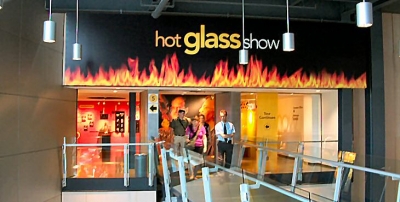
Covering centuries of the history of glass-making with items from around the world, C-MOG features numerous galleries with a multitude of glass items throughout human history.
Some of the featured items include Egyptian glass-making and an actual glass-smelting oven that was used, as well as medieval household glass objects, Phoenician and Roman glassware, Tiffany stained glass and Contemporary and Modern Glass Designs, and more.
Over the course of the two hours that we toured, I took nearly 200 photographs and can honestly say that I only photographed a very small fraction of the wealth of objects that are featured. In no particular order or grouping and with minor commentary, here are some of my favorite objects from our visit to Corning Museum of Glass.
Samples of the Objects in Display at the Corning Museum of Glass


Ancient Glass Bottles of Carthage

Carthage, a Phoenician colony outside of present-day Tunis, Tunisia was the first real opponent of Rome and they very nearly brought Rome to defeat. But Carthage finally fell to Rome and was rebuilt as a Roman city until it conquered yet again centuries later by invading Muslims.
Much of Carthage was certainly lost during the Roman campaign and occupation but perhaps much of Roman glassware art came from the Carthaginians. There are similarities in style of glassware during this time.
The Corning Museum of Glass has many such displays of Phoenician and Roman glassware. This is one of my favorite groupings (objects depicted are under a sealed glass case and Photoshopped by author to remove numerous overhead spotlight reflections.)
Metropolis in a Bowl
.jpg)
Like a city rising from the sunset itself, this more modern elegant glass bowl is illuminated from within and reminds me of sunset in the American southwest. The ragged spires at the top edge perhaps resemble Anasazi villages and clifftop dwellings. Or a modern metropolis?
Canning and Preserving Jars from Yesteryear

Growing up in the country I am somewhat familiar with canning and preserving. My mom used to can our garden vegetables, fruits and harvest meats in jars very similar to these older models.
Low acid items such as meats (turf, seafood and poultry,) all vegetables, and dairy products must be pressure cooked at 2400F to kill a specific bacteria that can cause botulism.
Immersed in several inches of water, this higher-than-boiling-water temperature can only be achieved using a pressure-cooking method.
High acid foods (anything with a low pH such as fruits & preserves, and pickles) can be safely canned/preserved using immersion in non-pressurized boiling water for a prescribed period of time. In both cases, the heat forces air out of the jar and when it cools, a vacuum seal is formed by the lid.
The heat has killed the microorganisms and the vacuum seal prevents atmospheric air from entry and introducing potentially harmful bacteria to come into contact with the food.
Glass in Nature: Tektites, Fulgurites, Obsidian, more
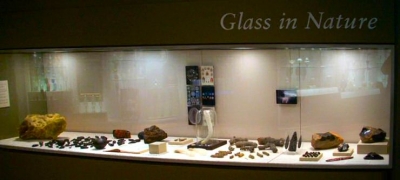
Of course I would be impressed by this display, replete with neolithic obsidian (stone) knives, Apache Tears, tektites, several Glass Sponges and Fulgurites (petrified lightning,) all creations of nature.


Neolithic Obsidian knives (left) - Tektites (center) which is glass that melted when it fell through Earth's atmosphere. What sometimes happens when lightning strikes the ground is shown with their collection of Fulgurites/Petrified Lightning (right)
TRUE Space Glass: A Window for the Gemini Space Capsule

Here is a window for the NASA space capsule of the Gemini series. Made with three different layers of glass, this piece has been on permanent display for decades.
I recall seeing this back in the 1970s when I first visited Corning Museum of Glass. I think that there used to be a glass window from the Space Shuttle series on display here as well although it is absent now.
Four Space Shuttles were initially made after the Enterprise glider (Columbia, Discovery, Atlantis and Challenger.)
After the Challenger exploded 73-seconds after liftoff in 1986, there was a 15-month shutdown of the Shuttle program during an investigation and overhaul of safety.
NASA Needed a Replacement Space Shuttle
NASA needed a replacement for the destroyed Challenger and it was briefly considered to retrofit the glider Enterprise, but it would be found to be cost-prohibitive. A new Shuttle made from available spare parts from the existing fleet was commissioned. The new Shuttle was named Endeavour.
If a required window for the Shuttle Fleet was ever present at Corning Glass Museum it would likely have been commandeered for the Endeavour project but this is just my speculation. At any rate, it was an amazing sight to once again see this object that was made for and specifically intended to fly in outer space.
Egyptian Glass Furnace (left) and Glass Artifacts Believed to have been Created using 'Lost Wax' Method


...from the third image: text below:
Lost-wax casting
The head of King Amenhotep II was probably made by "lost wax" casting. A model is carved in wax, then covered with fine clay. The wax melts, flows out through a small opening, and leaves a mold shaped like the original carving. Finely powered glass is poured in and heated until molten glass fills the cavity.
"Planet Globe" by the Corning Museum of Glass
This is one of my favorite items from the Museum. One of their most current and prized creations are their unique "Planet Globes" (gallery image below.) These are approximately 100-lbs solid glass spheres that have been built-up through layering from a smaller solid glass globe with countless elements affixed to the molten glass that represent waves of the oceans and clouds of the sky, plant life, fish and other marine life. Dipped multiple times are various stages of the build in thick layers of clear glass to increase diameter and 3-D depth, subsequent colors and elements are affixed to the surface of the globe.
The end result are layered with colored, clear and semi-clear sections with an incredible depth and clarity.
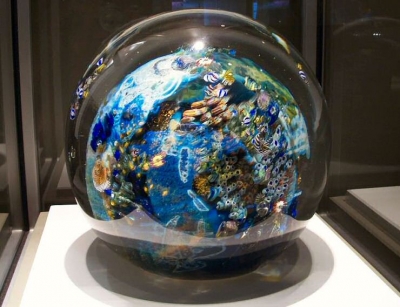
This new art form revealed many challenges and obstacles along the way to overcome. Production flaws such as warping/settling of the finished globe during the 12-week cool-down period and annealing cracks and were encountered. Greater learning at each subsequent attempt is apparent and the problems were eventually overcome.
The learning curve must have been incredible! Watching the video of the actual creation of the first one showed their frustration and disappointment with every failed attempt. Eventually, the masters of glass-making uncovered the correct formulas and methods and have been successfully repeating these creations with proficiency.
The museum itself displays the perfected Planet Globe as well as a large one in the Gift Shop. Involving the efforts of a team of skilled glass workers performing together, the finished product was a study in an untried technique and it is hardly a wonder that the 100-lbs. perfected Planet Globe in the Gift Shop retails for a whopping $44,000.00USD. There are a number of smaller ones for equally modest prices however.
If you attend the live glass-blowing you will see molten glass being stretched, pulled and bent. Glass is amazing and versatile. This one-of-a-kind museum brings the very best to show in its galleries. One cannot possibly take-in all the sights in just one visit and the images presented here cannot even begin to show all the wonderful man-made creations both ancient and modern that began as mere sand on some beach and human desire to create something useful, functional, enduring and beautiful.
(all images by author. Images clickable to view larger sizes via author's account at Flickr)