Awaiting the Return of the Monarch Butterflies
EducationAwaiting the Return of the Monarch Butterflies

Monarch Butterfly Caterpillar on Milkweed, A Sure Sign of Spring
Probably the most easily recognized butterfly of North America is the Monarch with its distinctive orange and black colors and patterns. The progeny of a migrated generation of these beautiful insects will arrive soon.
Young Monarch Caterpillar
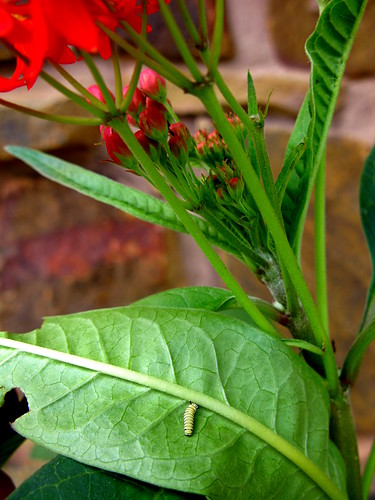
After the egg hatches the hungry caterpillar emerges and begins to feed immediately. The eggs are deposited upon one of several varieties of the family milkweed. Eating the slightly toxic leaves will impart a bitter taste to the caterpillar which extends into its adult life. Any bird that happens to eat a Monarch once or twice will remember the terrible taste and avoid orange & black butterflies in the future. For the protection of an entire species this bitter bad taste in every individual is an effective deterrent and little else is required.
Monarch Caterpillar Close-up

Like a skunk whose lack of fear allows it to forage and wander with impunity, the Monarch caterpillar seems confident that its defense mechanism is adequate and has no apparent concern over predation. Its open display of colors serves as a warning to not eat me for I taste bad. With just one taste predators leave this type of caterpillar alone. Some other insects mimic the colors of the Monarch butterfly to take advantage of this fact. The Viceroy butterfly has a very similar coloration but it lacks the noxious taste. Any bird or reptile that has tasted a Monarch will probably avoid a Viceroy butterfly just by association.
Monarch caterpillars have no defensive hairs or barbs like other caterpillars possess. Soft and fleshy to the touch, these insect creatures are a delight for young schoolchildren to handle and in North America at least, are often brought to school in a glass jar for show & tell. Watching a Monarch caterpillar's gluttony for milkweed leaves and eventual transformation into a beautiful butterfly is a quintessential right of passage for any school-aged child. This culminates with the release of the fully-fledged butterfly out the classroom window.
Amazing Colors of the Monarch
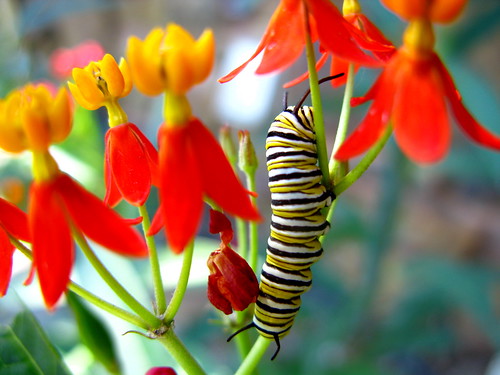
Wikipedia cites that the name "Monarch" was first used in published notes by Samuel Scudder in 1874 because of the size of the insect and vast range it inhabits. Another possibility cited is that these were so named to honor the English King William III. Either way, the Monarch butterfly rules the heart as it rules the sky. The visage of their colors on the undersides of milkweed leaves is always one of great contentment and joy for anyone whom has grown up in the country.
Monarch Butterfly Chrysalis
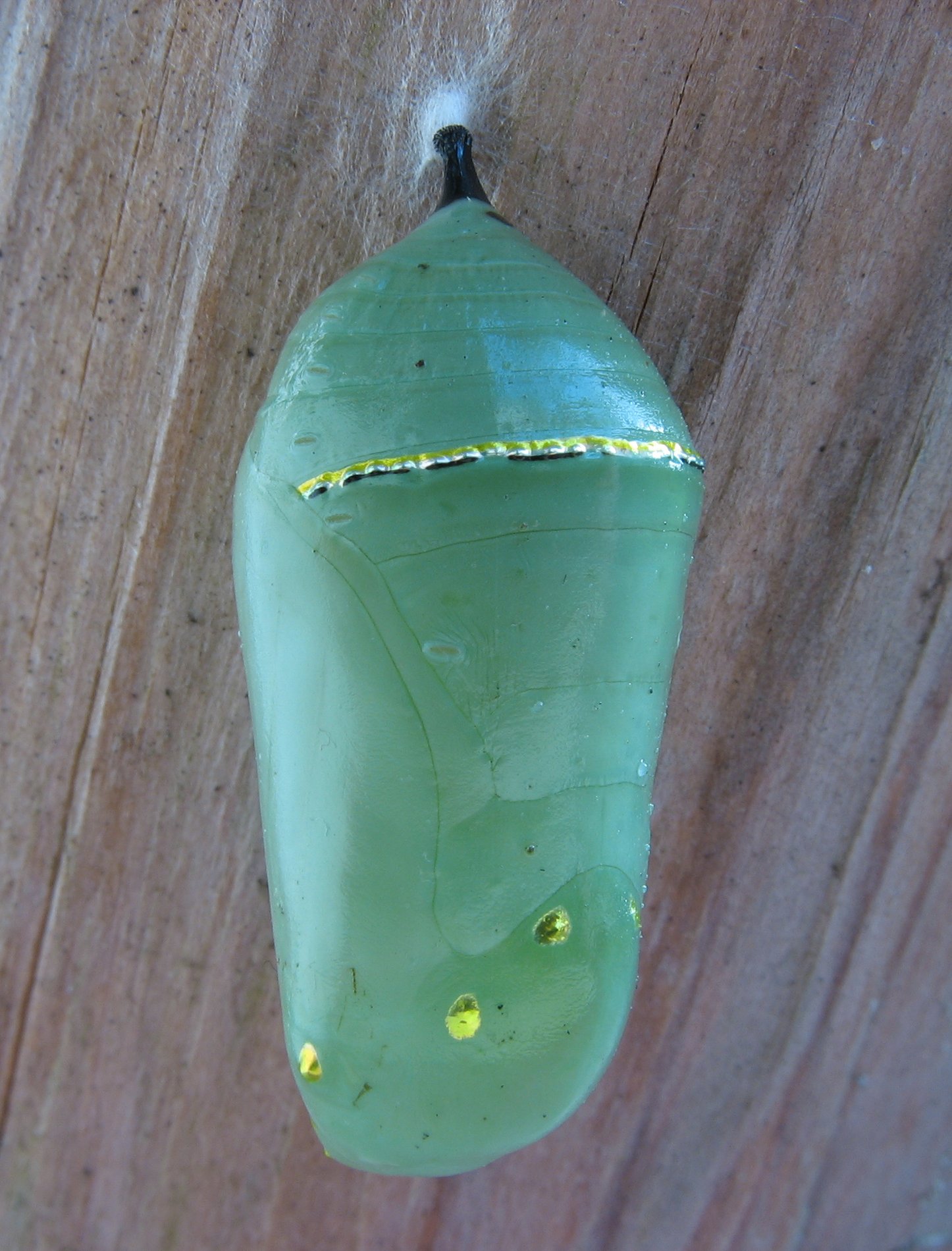
When the caterpillar has eaten its fill of milkweed and attained a nice plump bodily mass, it creates a silken cocoon called a chrysalis. The bright greenish-blue colors and yellow spots make the cocoon of the Monarch butterfly easy to recognize. As the pupae inside matures, the chrysalis begins to change to opaque. You can see the wings and legs of the butterfly through the thinning sidewalls of the chrysalis when it is nearly ready to emerge.
Stages of the Monarch Hatching

In this image we can see several stages of the transformation. When the newly-emerged butterfly climbs out of the dead husk of the chrysalis, its wings are still folded and small. It will gently exercise the new wings by slowly fanning them, and stroke its new wings forcing fluids to enter and expand. When the wings dry, the butterfly is ready for first flight.
Open Wings of a Monarch Butterfly

Monarch butterflies can be found all over North America, and since the 19th century they have been found in Australia, New Zealand and other island nations too. Monarchs sometimes make an appearance in Western Europe too, either lost or carried by winds to these non-traditional habitation grounds. Capable of making trans-Atlantic flights, Monarch Butterflies are not uncommon residents of some islands such as Bermuda.

Image via Wikipedia

It is suggested that the increased usage of some varieties of ornamental milkweed family of flowering plants gives them reason to stay. Perhaps the first Monarch butterflies of Bermuda were eggs imported on plants that were not inspected properly. They may have been an invasive specie. Here because of the warm and mild climate they remain perennially but their ability to navigate over oceans may allow them to leave and subsequent generations to return. They have colonized a new niche and they are willing to stay. Apparently they are a welcome guest here also.