All About Omega-3 Fortified Foods
EducationAll About Omega-3 Fortified Foods

For people who do not like eating fish, getting enough healthy omega-3 fatty acid can be hard. The food industry has been fortifying our food with omega-3. Are these fortified foods worth the money?
You can find refined white bread, margarine, cookies, ice cream, yogurt, milk, pasta and fruit juices all fortified with omega-3. These initial products didn’t do very well and are being phased out just in time for a whole new group of omega-3 fortified foods getting ready for the market.
Different Types of Omega-3 Fatty Acids
The omega-3 you get from plant foods like walnuts and flaxseeds are alpha-linolenic acid (ALA) and is a short chain fatty acid.
EPA (eicosapentaenoic acid) and DHA (docosahexaenoic acid) are the omega-3 fatty acids found in cold water oily fish and is more usable by our body. These are long chain fatty acids.
Omega-3 fatty acids are considered essential fatty acids because they are necessary for our health and our body cannot make its own, so we need to get it from our food.
Converting ALA to EPA and DHA Omega-3
ALA is converted in our body to EPA and then to DHA. Our bodies are not good at converting the ALA to EPA and DHA, so we do need to eat or supplement with the EPA/DHA form of the omega-3 fatty acids. Some conditions can prevent this conversion. Diabetics might not be able to convert the ALA to EPA/DHA.
The ALA that is converted in our body to EPA and DHA is not in a 1:1 ratio. It takes a lot of ALA type of omega-3 to equal EPA/DHA omega-3.
Most studies found that ALA is converted to about 5-10% EPA and 2-5% DHA [1]. So you can get the EPA/DHA by eating ALA containing foods and having your body convert it or you can get the EPA/DHA directly by eating certain types of fish.
This conversion rate also varies according to age, gender, health and the amount of omega-6 fatty acids in the diet. A diet high in the omega-6 foods can lower this conversion rate.
Recommended Daily Amount of Omega-3 Fatty Acids
Unfortunately there is no recommended daily amount (RDA) for omega-3, different groups have differing opinions. This is because each person’s daily requirement for omega-3 can be different.
- The USDA 2010 Nutritional Guidelines say that healthy people should get 250 mg (milligrams) of omega-3 per day [2].
- The American Heart Association says that people with heart disease should get 1,000 mg (1 gram) of omega-3 per day.
- The Linus Pauling Institute researched many studies with omega-3 and found that two small servings of oily fish per week gave great health benefits. This amount of fish would equal 500 mg of EPA/DHA per day [3].
- A group of nutritional scientists recommend we eat 650 mg of EPA/DHA and 2,200 mg of ALA per day.
Omega-3 Fortified Foods
According to Frost & Sullivan, omega-3 fortified food in the US typically has 32 mg of EPA and DHA, a fraction of most recommended daily amounts.
It appears at this time the food industry is saying that the recommended daily value for EPA/DHA is a rather low 160mg. Keep this in mind when looking at the percentages they give on their labels. If the label doesn’t specify which type of omega-3, you can be fairly sure it is ALA.
Yoplait Source Cardio omega-3 fortified yogurt has 300 mg in a 3.5 ounce serving. The nutritional facts do not say what type of omega-3, since it is a high number, I would guess it is ALA.
If the conversion rate of ALA to EPA/DHA is even at 10%, this would mean that this cup of yogurt gives you 30 mg of EPA/DHA omega-3. If we go with a recommended average of 500 mg of EPA/DHA omega-3 per day, you would have to eat 17 of these 3.5 ounce yogurt cups every day to get the equivalent of the same amount of EPA/DHA omega-3 fatty acids.
Some other omega-3 fortified foods include:
- Minute Maid enhanced pomegranate juice has 50 mg of DHA omega-3. Not bad, but this serving size also has 29g of sugar. The label says 36% of the recommended 160 mg of DHA per day which means 3 glasses and 88 grams of sugar and expensive to equal the recommended amount of DHA.
- Other fruit drinks like Tropicana and others had similar nutritional facts. I wouldn’t pay the extra cost for the added omega-3 and all of that sugar.
- Breads and pasta like Barilla have omega-3 products as well, they would be the ALA type because the have flaxseed in them. A good product but probably not worth the extra cost over the regular products.
- Smart Balance omega-3 buttery spread has 320mg of ALA and 32mg of the EPA/DHA.
- Some but not all of the omega-3 fortified eggs are of the ALA type because the hens were fed flaxseed. Others also have the DHA omega-3 from being fed algae or seaweed.
Cheaper Ways to Get Omega-3
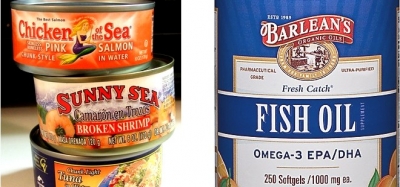
- By comparison, a 2 ounce serving of Chicken of the Sea canned salmon has 350 mg of EPA and DHA and no sugar or additives. The entire can has over 700 mg of the EPA/DHA omega-3 at a cost of $1.79.
- One of the more expensive and pharmaceutical grades of fish oil is made by Barlean’s and costs on average $13. There are 47 servings which is 28 cents per serving. Each serving has 850 mg of EPA and 540mg of DHA for an omega-3 total of 1,390 mg.
- Barlean’s cod liver oil is cheaper and has 440 mg of EPA and 460 mg of DHA for an omega-3 total of 900 mg. You don’t have to take either of these every day to get the USDA recommended total of 1,750 mg per week.
- If you don’t want the fish oil taste, GNC and other stores have many types of capsules. For example their triple strength capsule has 647 mg of EPA and 253 mg of DHA for an omega-3 total of 900 mg at a cost of $40 and 120 capsules. This is only 33 cents per capsule.
- The ALA type of omega-3 is also healthy. You can get a bag of ground flaxseed and sprinkle it on salads, put it in smoothies or on vegetables, plus you get healthy dietary fiber and it is gluten free. A tablespoon of ground flaxseed has 2.2 grams (2,200 mg) of the ALA omega-3.
The Future of Omega-3 Fortified Foods
At this time, the fortified ALA omega-3 market has flattened out and never took off as expected. The functional or fortified food industry expects the EPA/DHA omega-3 fortified foods to be the next popular products. Kellogg’s recently had a candy bar with 100 mg of DHA omega-3 added, but it has disappeared.
Egg producers like Oakdell Farms are producing omega-3 eggs that have both the ALA and DHA in them. They feed the chickens a mixture of flaxseed and algae, algae is a concentrated form of DHA omega-3. I think DHA fortified foods from algae is the next big step and could be worth the extra money if the product isn’t full of sugar and other unhealthy additives.
Warnings and Side Effects of Too Much Fish Oil
If you take a blood thinner, bruise easily or have other bleeding problems talk to your doctor before taking any fish oil supplements. Do not take a supplement of more than 3000 mg (3 grams) of fish oil per day unless directed by your doctor.
Amounts over 3000 mg (3 grams) per day are not recommended. Too much fish oil, whether supplement or eaten can cause bleeding. Some people report getting nosebleeds even with amounts of 1000 mg of EPA/DHA fish oil supplements every day.
Look at both the DHA and EPA and add the two together for the total omega-3 content.
Conclusion
Whether the food has ALA or EPA/DHA omega-3 added to it, the price usually will be higher than the non omega-3 product. Look at the amount and type of omega-3 added to the food plus all of the other ingredients like sugar, sodium and artificial ingredients that you do not want to eat along with the omega-3.
Some of these omega-3 foods could also be unhealthy processed foods, and with many of the omega-3 fortified foods, you actually could be hurting your health more if these foods are also high in omega-6 fatty acids.
Consider if it is cheaper and healthier to take a supplement or to eat a little fish and add some walnuts or flaxseed to your diet for a healthy amount of all types of omega-3 fatty acids.
Copyright © February 2011 Sam Montana
Resources
[1] PubMed Am J Clin Nutr. September 2003 vol. 78 no. 3 640S-646S
[2] USDA Nutritional Guidelines Appendices
GOED Global Organization for EPA and DHA Omega-3
Cover photo by Maggie Hoffman / Flickr.com