Facts About the Lionfish
EducationFacts About the Lionfish

One of the important rules of scuba diving is to avoid as much possible contact with anything underwater. Aside from disturbing the marine ecology, touching or collecting anything underwater may mean life or death to someone who does. A diver once collected a cone snail and pocketed it inside a pocket in his buoyancy control device. He didn't know that the cone snail has a very poisonous sting and it cost him his life.
One of those things that also have a poisonous sting and divers also avoid contact with is the lionfish. The lionfish has venomous spines that can cause so much pain when someone gains contact with it and get pierced. Their venom is extremely painful but there were no reported fatalities so far.
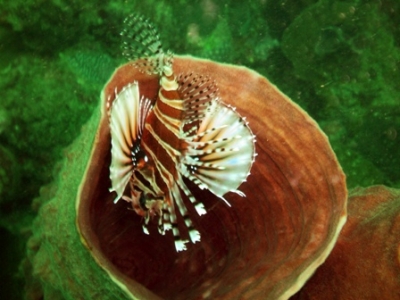
The lionfish enters the mouth of a sponge (Photo by Ofer Ben-Tzvi).
The lionfish can be seen in the shallow regions of coral reefs especially along the reef slopes, among crevices or lagoons. The lionship looks attractive with its alternating red and white stripes and a rounded tail. The pectoral fins look like two fans flanking both sides of its body and it swims usually slowly and appears nonchalant of predators. That's because they have very few natural predators or enemies except of course, man who has found its meat tasty and is a popular aquarium fish despite its venomous spines.
How big can the lionfish grow?
The lionfish can grow to a length of up to 43 centimeters while the juveniles may be shorter than 2.5 centimeters.
What does the lionfish eat?
The lionfish feeds on other smaller fishes but it may also feed on its own kind, exhibiting cannibalism. Cannibalism usually happens when there are few prey available. It is likely that the natural food of the lionfish is not that abundant compared to other species of fish.
When reared in the aquarium, the lionfish can eat live prey but do not feed on fish flakes just like the other fishes. However, they may feed on frozen food such as krill.
Distribution
The lionfish are known to occur throughout the western Pacific; from southern Japan to Micronesia, Australia and the Philippines. In other places, it has a close relative, Pterois volitans, that are distributed throughout most of the Ocenia east to French Polynesia.
What to do when stung by the scorpionfish
When stung by the scorpionfish, the best remedy is to ease pain. This can be done by cleaning the affected part by gently pulling the edges of the skin and scrubbing it with clean cloth. The affected part should be soaked in hot but not scalding water for 30 to 90 minutes. This will relieve pain because heat inactivates one of the toxins in the venom. This should be done repeatedly until the pain subsides.
A doctor must be consulted in cases where adverse reactions occur in the victim.
References
Schofield, PJ, JA Morris, Jr, JN Langston, and PL Fuller. 2010. Pterois volitans/miles. USGS Nonindigenous Aquatic Species Database, Gainesville, FL. Available at http://nas.er.usgs.gov/queries/factsheet.aspx?SpeciesID=963 RevisionDate: 6/29/2010